Linear Delusions: Why Malta's Finance Minister Failed Basic CalculusUpdate
When you have spent enough time grinding through university-level mathematical analysis and linear algebra, you develop a very low tolerance for bad statistics. Unfortunately, bad statistics are exactly what the Maltese government is currently peddling.
Finance Minister Clyde Caruana has been making headlines[1], doubling down on his terrifying projection that Malta’s population will reach 800,000 by 2040 if current economic models persist. He looks at the current influx of foreign workers, draws a straight line into the future, and hits the panic button.
This entire mathematical charade becomes even more transparent when you watch how the Prime Minister eagerly weaponizes these doctored projections. Instead of initiating genuine, sustainable economic reforms, he uses these intentionally flawed numbers as fuel for cheap populism.
It is the classic political playbook: first, you use an absurd linear graph to construct a terrifying bogeyman of infinite overpopulation, just so you can parade around as the strongman protector who will "crack down" with strict immigration quotas.
The fact that this hostile rhetoric actively alienates the exact workforce the economy currently relies on is a sacrifice they are perfectly willing to make for a round of cheap applause. Complex calculus doesn't win elections, but a simple, easily digestible scapegoat certainly does.
You would expect a Finance Minister to have a passing familiarity with how economic mathematics actually works. Because anyone with a calculator knows that complex socio-economic growth is never, ever linear.
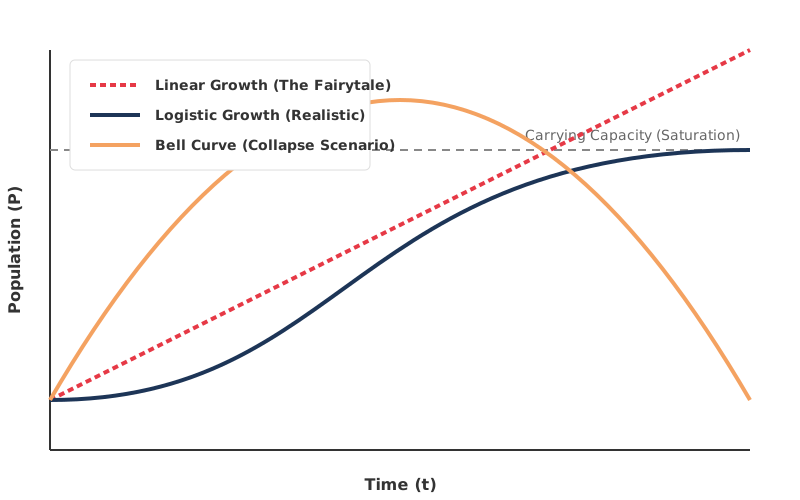
The Minister's Fairytale Math (Linear Growth)
Caruana’s entire doomsday scenario relies on the most basic, naive mathematical model in existence: linear progression. The formula he is effectively using in the background looks something like this:
Where is the future population, is the current population, is the constant rate of growth, and is time.
This formula assumes infinite resources. It assumes that the Maltese job market is an endless void, that housing can expand forever, and that demand for cheap labor will never wane. It is the kind of math a primary school student uses to calculate how many apples they will have next Tuesday. In the real world, markets saturate.
The Realistic Model (Logistic Growth)
In reality, economies and populations follow a Logistic Growth Curve. When the labor market in Malta becomes saturated, when all the catering jobs are filled, the iGaming sector stops expanding, and the construction boom cools down, the growth will flatten rapidly and noticeably.
The realistic formula that the Finance Ministry should be using looks like this:
Here, represents the "carrying capacity" of the system. The absolute maximum number of people the Maltese economy and infrastructure can sustain before the system stops generating new jobs. As the population approaches , the growth rate approaches zero. The curve flattens. The infinite straight line is a myth.
The Collapse Scenario (The Bell Curve)
But let us take it a step further, because over-saturation does not just flatten a curve—it can actively reverse it.
If Malta continues to import labor without expanding infrastructure, the island will simply become economically and socially unattractive. Rent will outpace wages entirely, traffic will gridlock permanently, and the quality of life will plummet. We have seen this happen in parts of the Arab Emirates, like Dubai, where hyper-rapid, unsustainable expansion led to massive exoduses of expat workers the second the underlying economy wobbled.
In this very realistic scenario, the population curve doesn't just flatten; it drops, resembling a Gaussian function or a parabolic bell curve:
In this equation, once we hit the peak time of maximum saturation , the systemic failures make the island unlivable, and the population sharply declines as foreign workers leave for better opportunities.
The Political Smokescreen
So, why is a highly educated Finance Minister pretending that growth is linear?
Because it is a political tactic. By projecting a terrifying, mathematically impossible 800,000 population, the government is deliberately stoking fear to justify a strict, legislative cap on immigration quotas.
But this is where they shoot themselves in the foot again. If you artificially cap the necessary influx of workers before the economy has actually stabilized or modernized, you starve the businesses that rely on them. You make the country instantly uncompetitive. By trying to prevent an imaginary straight line from reaching 800,000, they will artificially trigger the economic decline they are pretending to prevent.
Mathematics is complex. It requires factoring in saturation limits, infrastructure degradation, and human behavioral economics. It is a shame the government prefers to use a ruler and a crayon. But that`s how populism work. Ask the brits - they learned where making up numbers this ways can end.
Update: The 2040 Forecast (For the Critics in My Inbox)
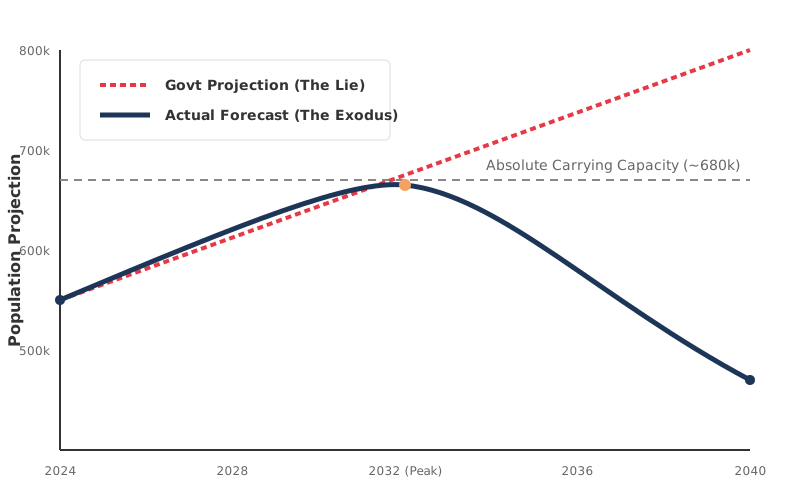
Since publishing the original post, my inbox has been pinging with a few annoyed emails accusing me of just being a cynic who loves to complain without offering a concrete alternative projection. Fair enough. If you want a realistic, data-driven forecast of what Malta’s economy and population will actually look like by 2040—instead of the Finance Minister's linear science fiction—here it is.
Grab some popcorn, because the math is unforgiving.
Phase 1: The Squeeze (2026 – 2029)
We are currently in the final acceleration phase of the logistic curve. The government and developers are desperately trying to cram more units into a finite space. During these next three years, we will hit the absolute limits of the island's carrying capacity .
- The Reality: The power grid will continue to fail every summer. Traffic will shift from "annoying" to "systemically paralyzing." Rent prices will decouple entirely from the median wage of the imported service workers.
- The Economy: We will see the first major cracks. Businesses in catering and basic services will close not because of a lack of demand, but because their staff can no longer afford a bed in a shared apartment, causing a severe labor shortage in low-wage sectors. Actually the talks about overpriced beds and harsh conditions made by greedy landlords in Malta start to grow in India and Pakistan. The "Come to Europe and get rich" promotions on India Social Media start to be seen as what it is: A scam/slavery scheme. I mean when a company does not pay on time or to low, this messages will reach families in other countries. And there are a lot of examples, like the "Fake Roman Village" in Gozo, where the operater does not pay the foreignes for month. That all start to produce a feedbak. It's the 101 of economics.
Phase 2: The Tipping Point (2030 – 2032)
This is where the linear fairytale shatters against the brick wall of reality. We will hit aka. the absolute peak saturation point. The population will likely plateau somewhere around 650,000 to 680,000. It will never reach 800,000.
- The Reality: Malta loses its primary competitive advantage: it is no longer a cost-effective or attractive place to live for expats.
- The Economy: The highly mobile, high-yield sectors—specifically iGaming, fintech, and tech startups—will begin executing their exit strategies. These industries are not anchored to the physical rock of Malta; they are anchored to tax incentives and talent retention. When talent refuses to relocate to an overpriced, gridlocked island, the companies will silently pack up their servers and shift to the next emerging European hub (think Cyprus, or even back to heavily subsidized mainland tech parks). I work in a company with branches in United Kingdom and easter Europe. They will shift very easy. And they are strong enough to move to Cyprus with ease.
Phase 3: The Bell Curve Exodus (2033 – 2040)
Once the economic anchor industries leave, the construction and real estate bubble loses its foundation. This is the downward slope of the Gaussian curve.
- The Reality: Emigration overtakes immigration. The foreign workforce, which owes no loyalty to the island when the jobs dry up and leaves in droves.
- The Economy: We will witness a harsh market correction. Thousands of quickly built, poor-quality apartment blocks will sit empty. Landlords who over-leveraged themselves to buy buy-to-let properties will default, putting immense pressure on the local banking sector.
By 2040, Malta’s population won't be 800,000. The exodus will likely drag the numbers back down below 550,000, leaving behind a scarred infrastructure and a massive oversupply of empty concrete boxes. It is the classic "Dubai effect," just without the infinite sovereign wealth fund to bail it out.
Sources
1 Times of malta: Watch: Clyde Caruana stands by 800,000 population projections despite PM claim